

SONO Generations · Kids
Printable workbooks · Ages 3–10

Owning is taught at home.

Nobody set your business as an assignment. No syllabus, no deadline handed to you, no one marking it at the end. A classroom rehearses the opposite instinct year after year — wait to be told, find the one right answer, hand it in on time — and most of what is sold to teach children money was built the same way. These three printable workbooks teach the half that gets left out, from a jar of coins at three to a mortgage worked out on paper at ten.

a workbook · for all three

Instant PDF download · Print as often as you like · One licence per family

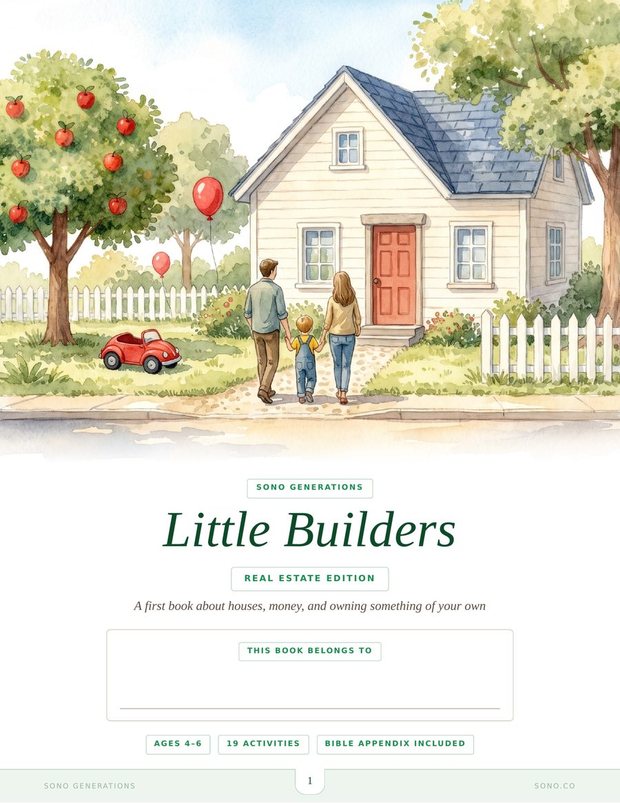
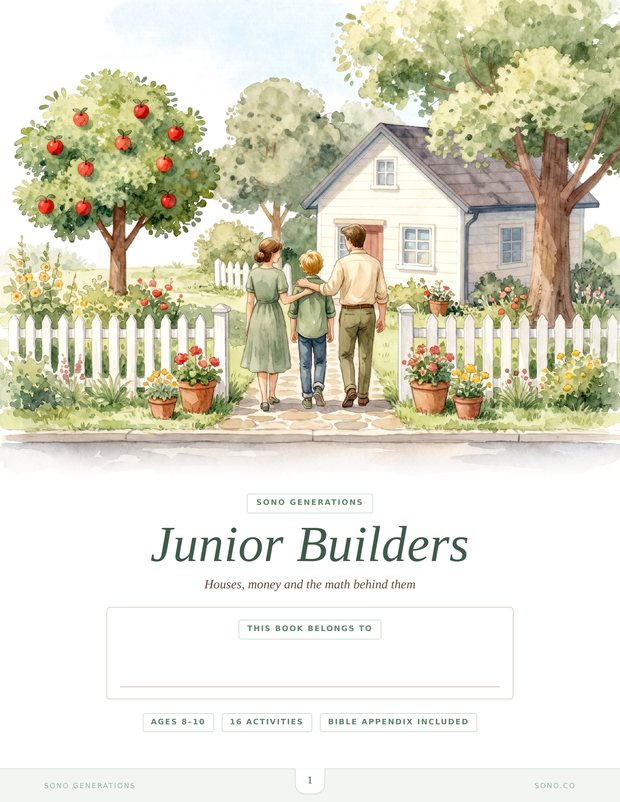
Cover of Tiny Builders, ages 3 to 4 Cover of Little Builders, ages 4 to 6 Cover of Junior Builders, ages 8 to 10
93 printed pages across three workbooks and a supplement
7 years of it, ages three to ten
10 ideas, taught three times over
0 screens involved
Watercolour of the same cottage in spring, summer, autumn and winter
Why we made these

School is doing exactly what it was built to do.

It was built to produce people who can be employed: follow the syllabus, meet the deadline, sit the exam, be graded by somebody else. Those are real skills and your children need them. The difficulty is that several of them run exactly backwards to what building something asks for — and they are practised early enough, and often enough, for the habit to set.

1

The instincts run backwards

A business is a wrong answer survived long enough to turn into a right one. A test marks the wrong answer in red and moves on. One trains a child to wait for permission and produce the expected thing; the other only ever pays the person who decided before anyone asked. Both can be learned. Only one of them gets practised daily.

2

Leaving the classroom does not leave the syllabus

Most of what is sold to teach a child money is a classroom in a box: a unit, a quiz, one correct number in the blank. And nearly all of it stops at saving — spend, save, give, with the jar as the hero. A fine habit, and not how anything gets built. A jar of coins is the same jar of coins next year. Nobody ever started anything by being taught only to wait.

3

And you are not writing a curriculum

You are running the business. That is the point of all this, and it is also the problem: the parent best placed to teach ownership is the one with the least room to build a course around it. What is needed is something printed, in a folder, that a grown-up hands over with one sentence read out loud, and then gets on with the day.

Every other money product

Spend. Save. Give.

  • Three jars on a shelf
  • A chore chart and an allowance
  • Coins named and counted
  • A quiz at the end of the unit

All of it useful. None of it ownership. A jar of coins is the same jar of coins next year.

What your child learns here

Ten ideas, three reading levels.

  • What Is an Asset?
  • What Is a Loan?
  • What Is a Mortgage?
  • What Is Equity?
  • Rent or Own?
  • Needs, Wants and a Budget
  • Spend, Save, Invest
  • Our Money Meeting
  • My House Tour
  • Curb Appeal Detective

Saving keeps a dollar a dollar. Investing turns it into more — and that is page seven, not the finish line.

Three printable workbooks, from · instant PDF download

The one idea

Some people are paid for their hours. Some own the thing that pays.

Schooling rehearses the first one daily. The second is never mentioned.

That is not an accusation. Both of those people can be good at their work, well paid and well thought of, and most lives contain a stretch of each. The difference is only what happens when they stop. An hour that has been sold is gone. A building, a business, a share of something keeps working overnight — and the person who owns one had to learn, somewhere, that owning was a choice available to them at all.

Property is the easiest version of that lesson to teach, because it is the only asset a four-year-old can stand inside. You cannot show a child a share certificate. You can walk them through a house, point at the roof, and tell them somebody owns this and is paid every month because of it.

Ages 3 to 10 · from · 30 days to change your mind

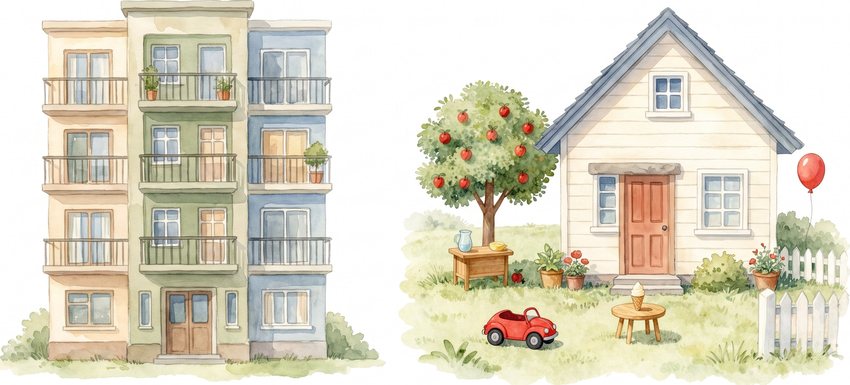
Watercolour of an apartment block beside a small house with a garden
And the mechanism under it

Saving keeps money the same size.

The goal is investing, not saving. Saving was never the objective.

Saving appears in all three workbooks — but always as keeping money the same, never as the finish line. A three-year-old meets it as a jar with three coins in it that will still be three coins tomorrow, on the page facing a berry bush that carries more fruit every year than it did the year before. A five-year-old meets it as rent going out against a mortgage coming down. An eight-year-old meets it as equity, amortisation, and a budget with a line in it for investing.

Everything else follows from getting that one thing the right way round early, before anybody has to unlearn it.

Three workbooks, ten ideas, three reading levels · from

Watercolour of a child picking berries from a bush that fruits again each year
What's inside

The same idea, three times.

Read across a row, not down a column. The lesson never changes between the workbooks — only what a child is asked to do with it. Every image is a page from the actual PDF, and every sentence in quotation marks is printed on the page above it.

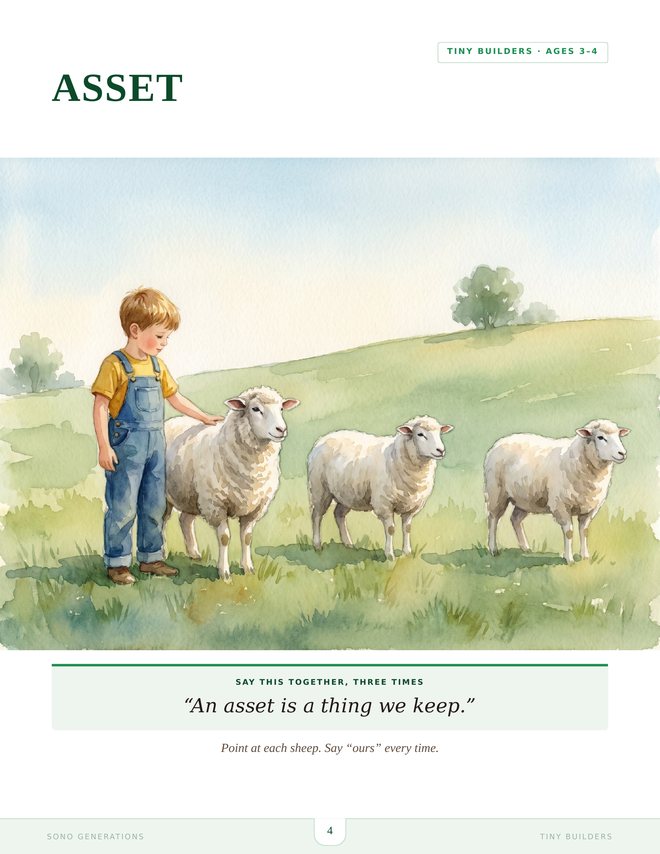
Asset

At three it is a thing you keep. At nine it is a thing that pays you.

Swipe to see all three ages →

The ASSET page from Tiny Builders, a watercolour of sheep in a field
Ages 3–4 An asset is a thing we keep. Point at each sheep. Say ours every time.
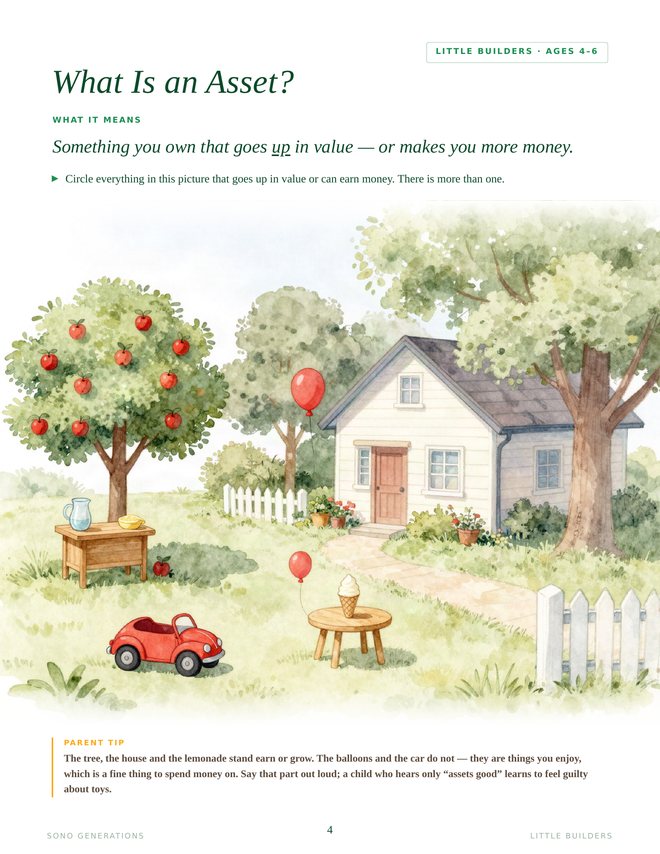
The What Is an Asset page from Little Builders
Ages 4–6 Something you own that goes up in value — or makes you more money. Circle everything in the picture that goes up in value or can earn money. There is more than one.
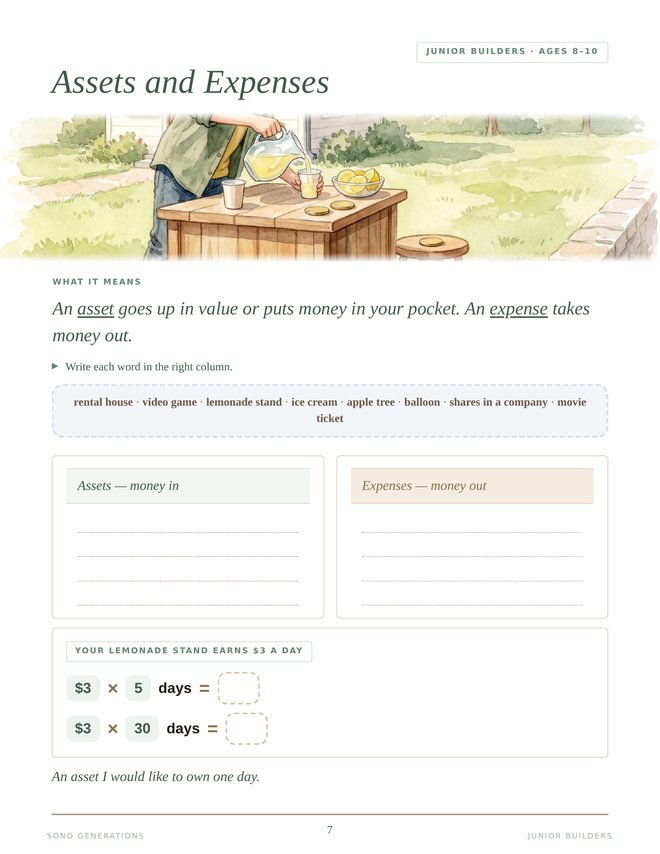
The Assets and Expenses page from Junior Builders
Ages 8–10 An asset goes up in value or puts money in your pocket. An expense takes money out. Eight words sorted into two columns, then a lemonade stand's $3 a day worked out over 5 days and over 30.

Mortgage

Four words, then a sentence, then the arithmetic.

Swipe to see all three ages →

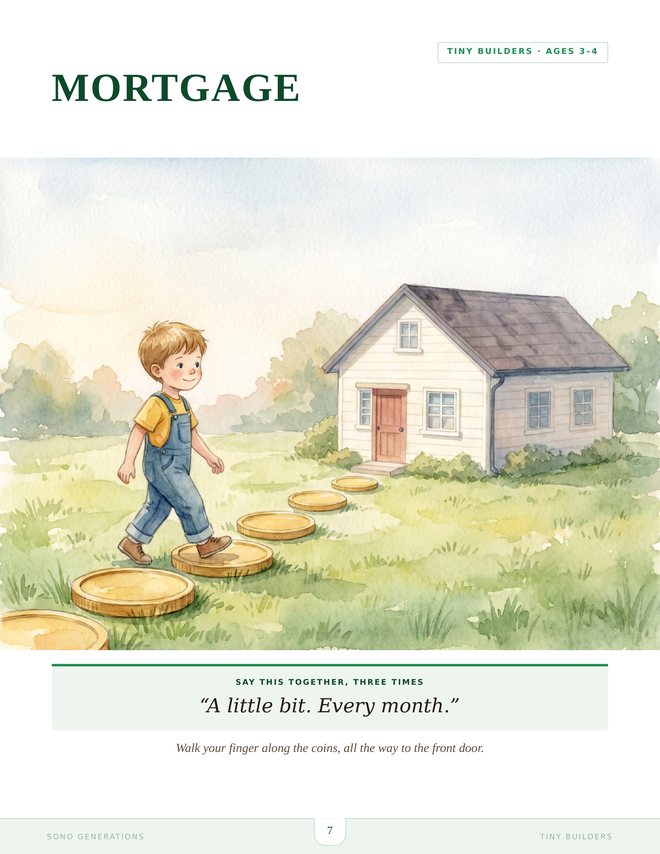
The MORTGAGE page from Tiny Builders, a watercolour of a boy following a path of coins to a house
Ages 3–4 A little bit. Every month. Walk a finger along the coins, all the way to the front door.
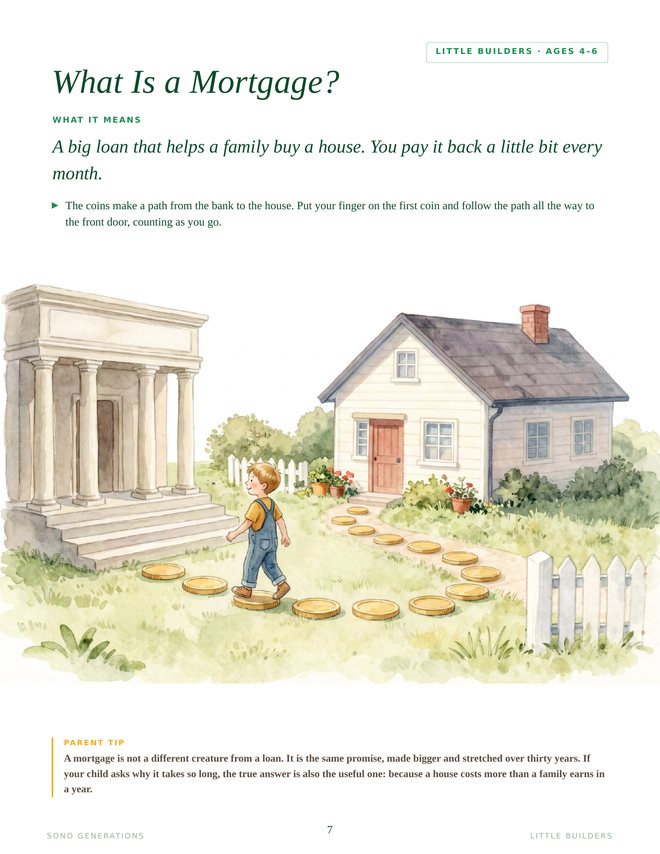
The What Is a Mortgage page from Little Builders
Ages 4–6 A big loan that helps a family buy a house. You pay it back a little bit every month. Follow the coin path from the bank to the house, counting out loud as you go.
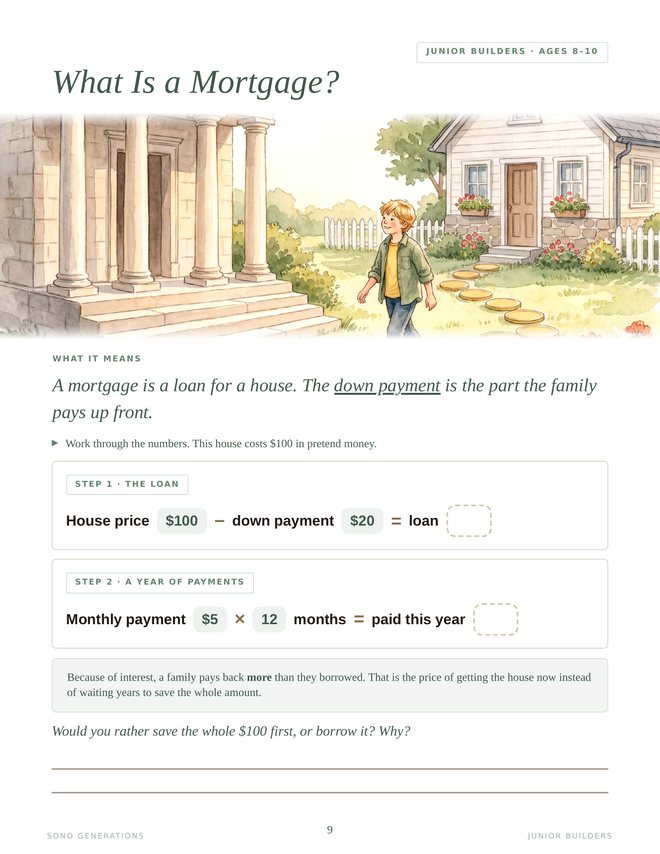
The What Is a Mortgage page from Junior Builders
Ages 8–10 A mortgage is a loan for a house. The down payment is the part the family pays up front. $100 − $20 gives the loan. $5 × 12 gives the year. Both answers left blank.

Equity

The word most adults cannot define, arriving three times before ten.

Swipe to see all three ages →

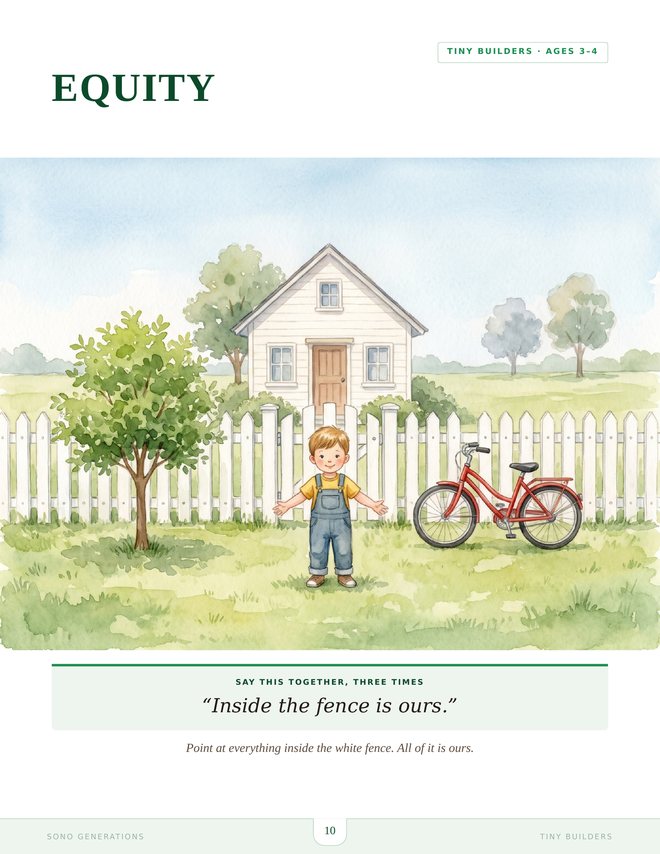
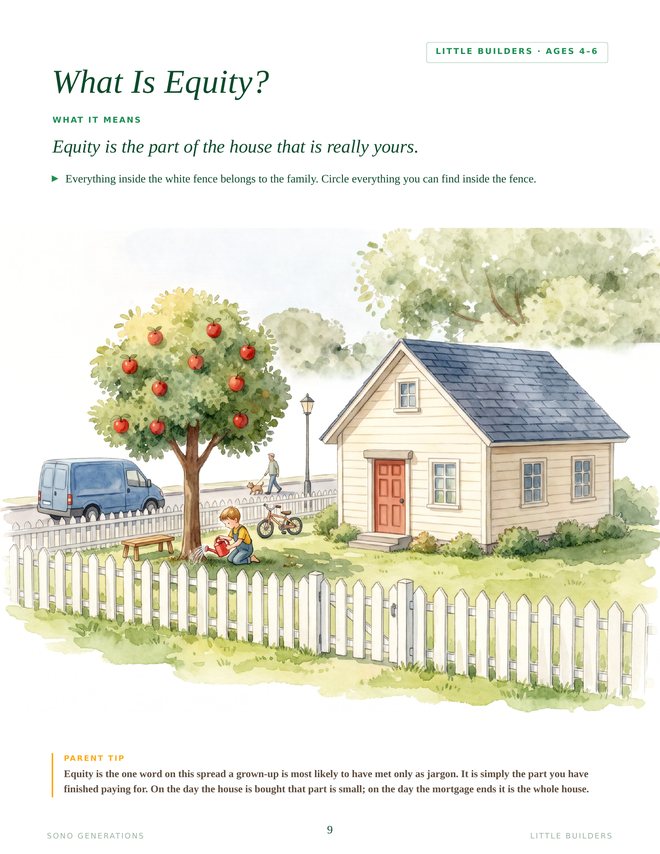
The EQUITY page from Tiny Builders, a watercolour of a house and garden behind a white fence
Ages 3–4 Inside the fence is ours. Point at everything inside the white fence. All of it is ours.
The What Is Equity page from Little Builders
Ages 4–6 Equity is the part of the house that is really yours. Circle everything inside the white fence. That part belongs to the family.
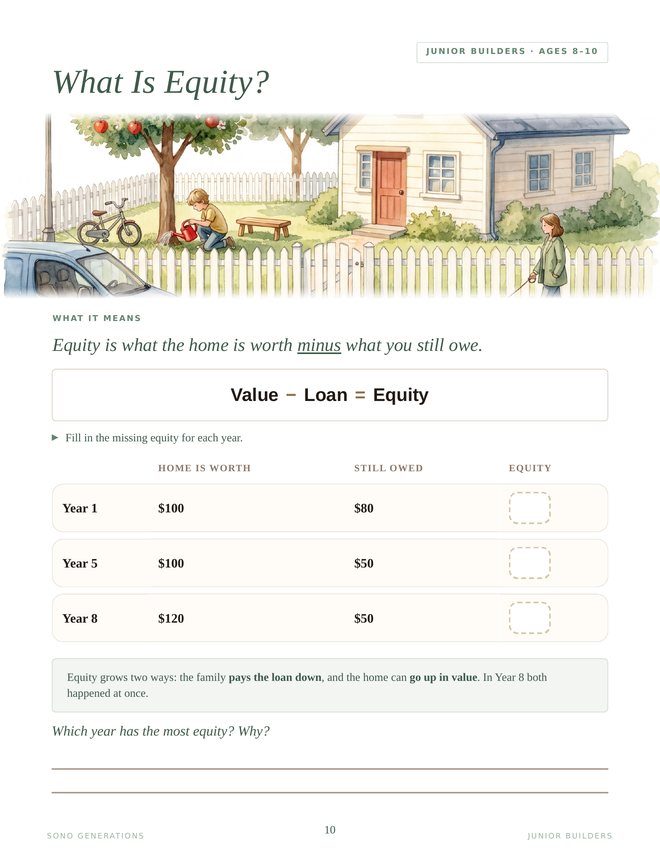
The What Is Equity page from Junior Builders
Ages 8–10 Equity is what the home is worth minus what you still owe. Value − Loan = Equity, worked out for year 1, year 5 and year 8 — then: which year has the most? Why?

The money meeting

The same table, the same day of the week, for seven years.

Swipe to see all three ages →

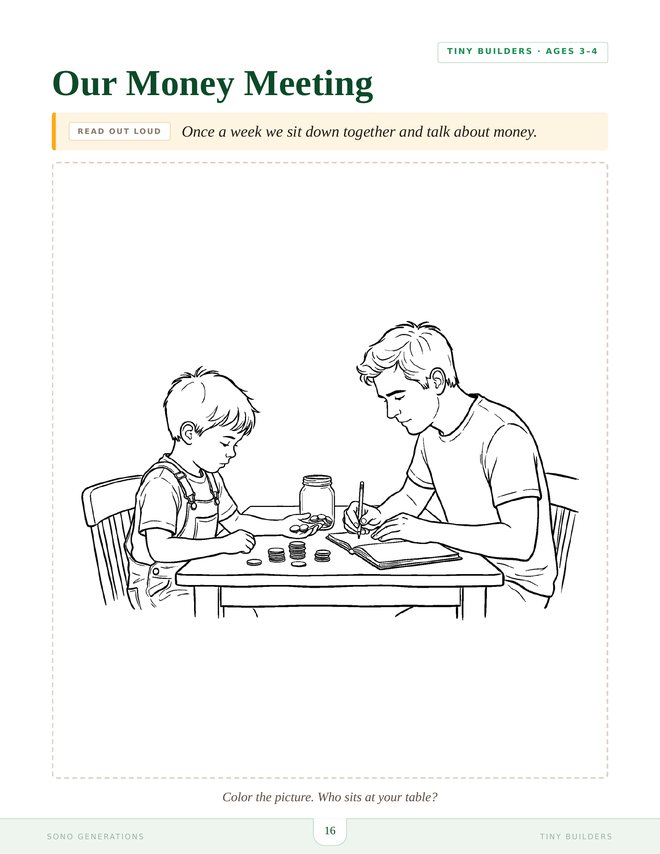
The Our Money Meeting page from Tiny Builders, a line drawing of a parent and child at a table, ready to colour
Ages 3–4 Once a week we sit down together and talk about money. Colour the picture. Who sits at your table?
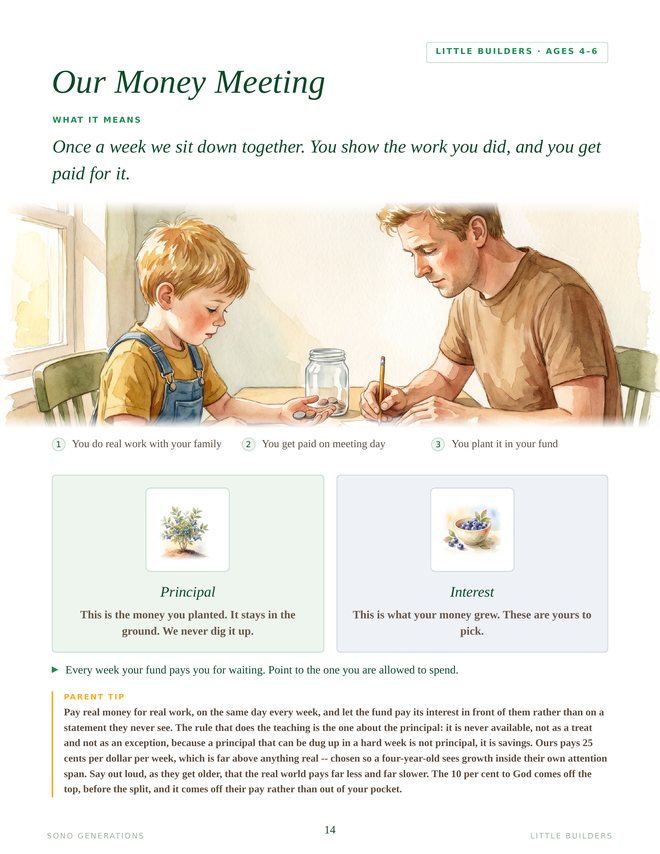
The Our Money Meeting page from Little Builders
Ages 4–6 Once a week we sit down together. You show the work you did, and you get paid for it. Real work, paid on meeting day, then planted in a fund that pays them for waiting.
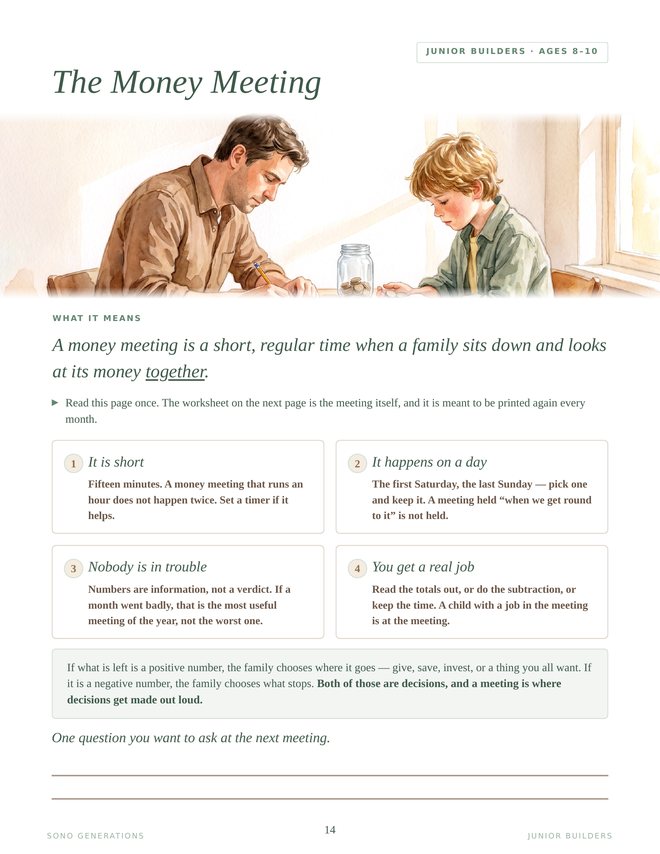
The Money Meeting page from Junior Builders
Ages 8–10 A money meeting is a short, regular time when a family sits down and looks at its money together. Fifteen minutes, on a day you pick and keep, and nobody is in trouble.

Every page above is in the PDF you download · a workbook, for all three

Where to teach it

An open house is a free field trip.

It is the only place you can walk a child through a six-figure asset on a Saturday afternoon, at no cost, and be welcomed at the door for it. Whether property is your work or you are going deliberately to teach, two pages in these workbooks are built to be carried there on a clipboard.

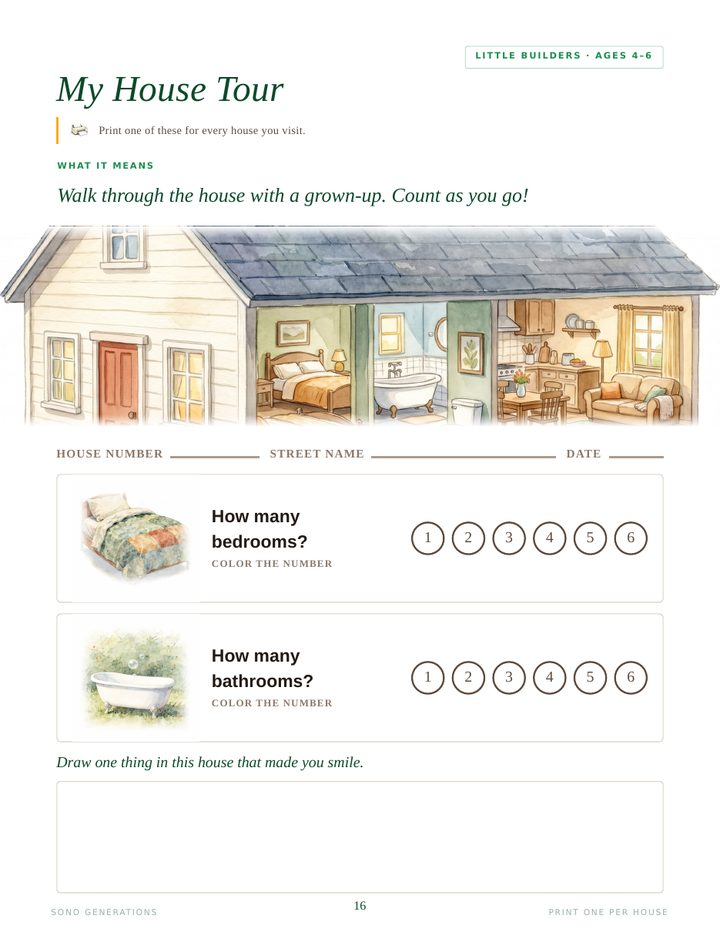
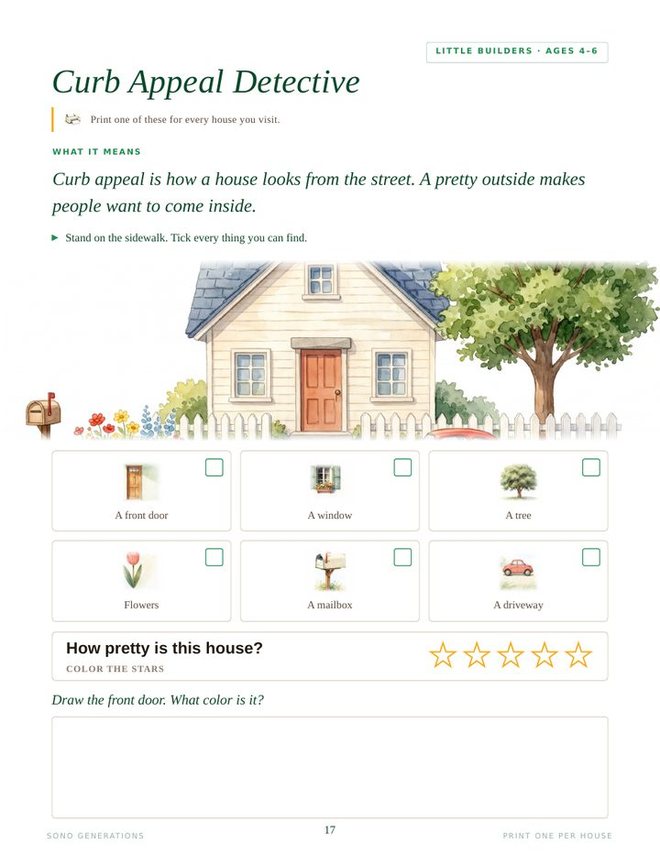
My House Tour walks a child through a property counting bedrooms and bathrooms and writing down the street name. Curb Appeal Detective asks them to stand at the kerb and work out why one house looks cared for and the one beside it does not.

Both are in Little Builders and Junior Builders, pitched differently for each age. They are the pages that get printed four times and go missing in the footwell of the car, which is exactly what they are for.

The My House Tour page, a worksheet for counting rooms at an open house The Curb Appeal Detective page
The free My House Tour sample page
Free

Take one page to your next open house.

My House Tour, the full page, free — the same file that is in the workbook, not a cut-down version of it. Print it, put it on a clipboard, and find out whether your child actually uses it before you spend anything.

One email with the PDF attached. Unsubscribe in a click.

What they end up knowing

A four-year-old who can tell you what equity is.

Not one day. By the end of the workbook they are holding. Every line below is quoted from the page it appears on.

Tiny · 3–4

They will say the words.

Asset. Loan. Mortgage. Equity. Invest. Generous.

Six words, one per spread, each on a picture of the real thing — a car, a front door, a bed, a jar. The note to grown-ups at the front is blunt about the ambition: “Your child is not meant to understand these words. They are meant to be able to say them. Understanding is what the next book is for.”

Little · 4–6

They will know what they mean.

Equity is “the part of the house that is really yours.” A mortgage is “a big loan that helps a family buy a house — you pay it back a little bit every month.” Renting pays someone else; owning is yours to keep. And on money: “Money can do three jobs. Investing is the best one.” Our Money Meeting is where they show the work they did and get paid for it.

Junior · 8–10

They will do the arithmetic.

A loan paid down week by week in a table they fill in themselves, with the interest written in at the bottom. Value − Loan = Equity, run three times, then the question “Which year has the most equity? Why?” Assets sorted from expenses — “an asset goes up in value or puts money in your pocket; an expense takes money out.” Curb appeal scored at the kerb, because it “changes what buyers are willing to pay.” And a dream house designed without going over budget.

The workbooks

One idea, three ages.

Buy the one that fits the child in front of you, or take all three and grow into them. Each is an instant PDF download.

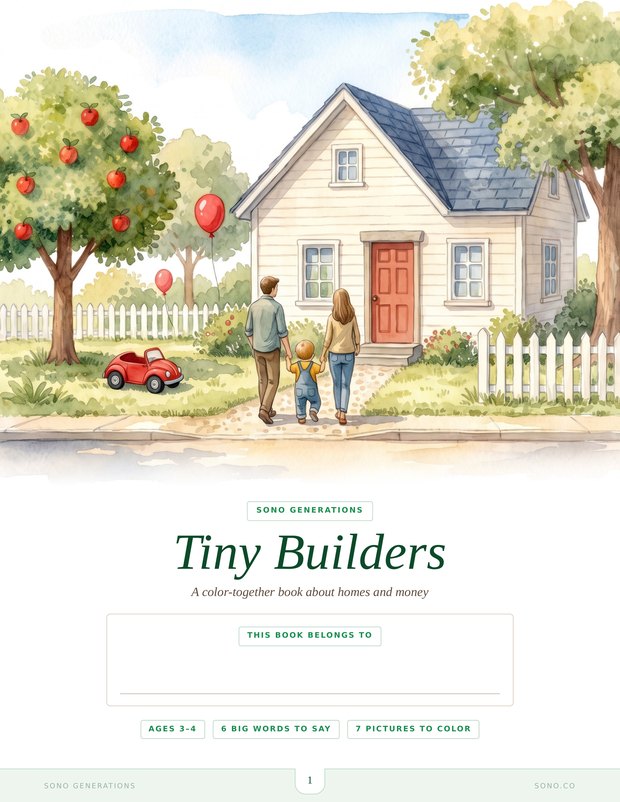
Tiny Builders cover

Ages 3–4

Tiny Builders

18 pages · six words to say, seven pictures to colour

  • Asset, loan, mortgage, equity, invest, generous — one word a spread
  • One sentence to say together three times, then a picture to colour
  • A jar of coins beside a berry bush — the whole idea, at three
  • A four-week money-meeting sheet for the fridge
Little Builders cover

Ages 4–6 · most popular

Little Builders

28 pages · 16 activity pages + a 9-page appendix

  • Asset, loan, mortgage, equity, rent or own — each in a picture and one sentence
  • Circling, colouring, number tracing, counting to twelve
  • My House Tour and Curb Appeal Detective, for real open houses
  • The Biblical Stewardship appendix included, six lessons, NKJV
Junior Builders cover

Ages 8–10

Junior Builders

26 pages · 13 activity pages + a 9-page appendix

  • Percentages, multiplication and subtraction on real figures
  • A mortgage broken into a loan, a down payment and a year of payments
  • A budget with needs, wants and a line for investing
  • Design Your Dream House, drawn and then costed
  • The Biblical Stewardship appendix included, seven lessons, NKJV
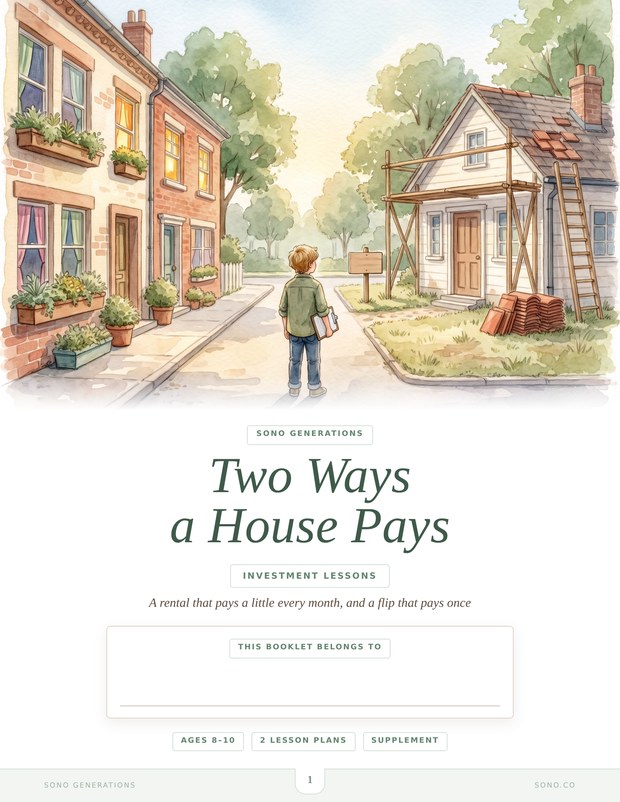
Two Ways a House Pays cover

Ages 8–10 · a supplement, not a fourth tier

Two Ways a House Pays

21 pages · two lesson plans, about forty minutes each · for families who already have Junior Builders

For the child who has finished Junior Builders and wants the next real thing. Lesson one is a rental: where every dollar of the rent actually goes, and what one empty month costs. Lesson two is a fix-and-flip, budget and all — including the flip that loses money, worked through to the end rather than left out.

Ages 6–8 · finished, being painted

Growing Builders

26 pages · the missing middle, between Little and Junior

The same ten ideas again, at the age they stop being pictures and start being sums. A house that costs $10 and a loan that is paid back in number bonds to ten, a mortgage counted on to twelve months, and the Biblical Stewardship appendix at its own reading level.

Waiting on its watercolours

Leave your email with the free page and you will be told the day it is ready.

Everything, together

A ten-year-old who wants the pool and still comes in under budget.

All three workbooks · seven years of it, in one download

  • Tiny Builders, Little Builders and Junior Builders, complete
  • The Biblical Stewardship appendix, also supplied on its own
  • Both open-house pages at two reading levels
  • Licensed for your whole family — print every page as often as you like
  • Free updates to every edition you have bought
Get all three

Instant download · No account to create · 30 days to change your mind

The four R's

A five-year-old who knows which day the family talks about money.

Money is the last thing a family hands down. The first things are invisible, and they are what decides whether a business or a portfolio survives its second generation at all. Every workbook carries the same page explaining the four R's — written for you, not for the child.

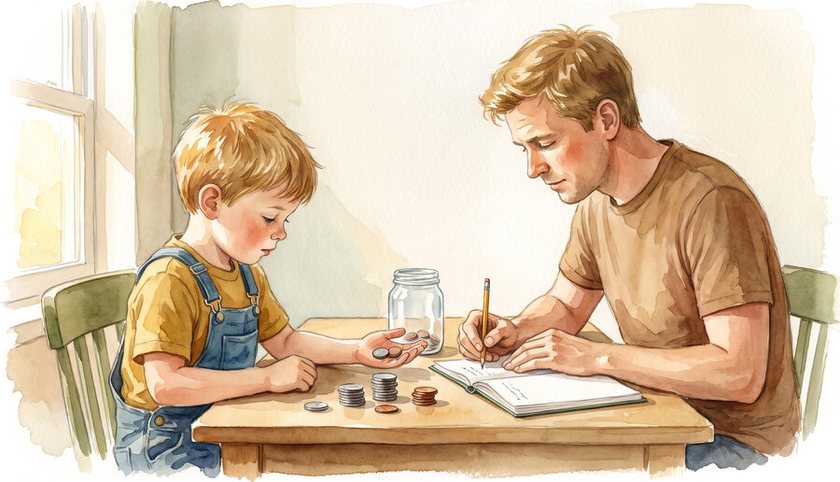
Watercolour of a father and child counting coins at the kitchen table
ReasonWhy we build

A family that knows why it is building makes better decisions and outlasts the hard years.

RelationshipsWho we build with

You cannot hand anything to people you do not have a relationship with.

RhythmsWhat we repeat

Weekly family meetings, business days, a shared day of rest. Ordinary weeks, repeated for years.

RealityHow we see

Gratitude instead of entitlement. Failure treated as tuition rather than shame.

All three for · instant download · no account to create

Questions

Before you buy.

What exactly do I get?

A PDF, immediately, by email and on the confirmation page. Letter size, 8.5 × 11 inches, designed to print at home on an ordinary printer. Nothing physical is shipped and nothing arrives in the post.

We don't work in real estate. Is this still for us?

Yes — and a good share of the people these were written for are in exactly that position. Nothing in the workbooks assumes a parent who sells property. They assume a parent who wants a child to understand what owning one means, which is a different thing and a more common one. The two pages built for open houses work just as well when you go to an open house deliberately, to teach, as when you were going to be there anyway. Going on purpose is a perfectly ordinary Saturday.

We homeschool already. How does this fit?

It is not a curriculum and it is not trying to be one. No scope and sequence, no unit tests, nothing to grade, no pacing guide to fall behind. Ten ideas, a page or two each, sitting alongside whatever you already run — most families do one page in a sitting and then go and look at a real house. If part of why you left was that the system trains the wrong instincts, this is the piece most boxed curricula still do not cover, because they were built from the same template.

Isn't three too young for any of this?

Too young for mortgages, certainly, which is why Tiny Builders never mentions one. What a three-year-old can hold is much smaller: this is a home, homes cost money, here is a jar with three coins in it, and here is a bush with more berries on it this year than last. That is the whole lesson at that age. It is also the foundation the other two workbooks are built on top of, which is why it is worth laying properly rather than waiting until somebody is old enough for the interesting version.

How many times may I print it?

Licensed for use by one family. Print as many copies as you like for your own children. Not for resale, redistribution, or use by a co-op, classroom or group without a separate licence.

Which in practice means: print the House Tour page forty times if you go to forty open houses. That is what it is for.

Do I need a colour printer?

For Tiny Builders, no — it is a colouring book, and the pages your child works on are line drawings that are meant to come out black on white. For Little Builders, Junior Builders and the lesson plans the artwork is watercolour and colour is worth having, though every activity still works in greyscale — the writing lines, tables and answer boxes are all black.

My child is seven. Which one?

Honestly, neither is aimed exactly at seven. Junior Builders was originally drafted for six to eight and proved too advanced, so it moved to eight to ten and we left the gap rather than pretend it wasn’t there. A confident seven-year-old reader will manage Junior with a grown-up alongside; a reluctant one is better served by Little Builders, which they will finish rather than abandon.

That gap is closing. Growing Builders, ages six to eight, is written and paginated — 26 pages, the same ten ideas, the appendix at its own reading level — and is waiting only on its watercolours. If your child is seven and not in a hurry, it is worth waiting for.

Is this a religious product?

Not in the main workbooks, deliberately. The Biblical Stewardship material is a separate appendix — NKJV throughout, six lessons in Little Builders and seven in Junior, supplied as its own file as well as bound into the workbook — precisely so that the workbooks stay usable by any family. If you want it, it is there. If you don’t, nothing in the other pages depends on it.

Do the three workbooks repeat each other?

On purpose, yes. They teach the same ten ideas at three reading levels, and where possible they use the same artwork — the cottage a five-year-old meets in colour is the cottage their little brother colours in outline. That recurrence is the point. A child who moves up a tier meets an old friend, not a new syllabus.

What if it isn't right for us?

Email within thirty days and you get your money back, no explanation needed. You keep the files — asking somebody to un-download a PDF is theatre. Take the free House Tour page first if you would rather test it before spending anything.

Placeholder — invented quotes, for layout only. Replace or delete before launch.

From other families

What parents say.

We had already left school precisely because of the instinct-training, and then bought three money curricula that turned out to be school in a folder. This is the first thing that isn't.
Placeholder nameHomeschooling three, ages 4 to 9
My eight-year-old worked out the mortgage payment on the page and then asked me what ours was. We have been running the business in front of her for years and she had never once asked.
Placeholder nameRuns a two-person agency
The House Tour page has been printed so many times there is a copy in the car door. That is the highest praise I can give anything I have bought as a PDF.
Placeholder nameBought all three
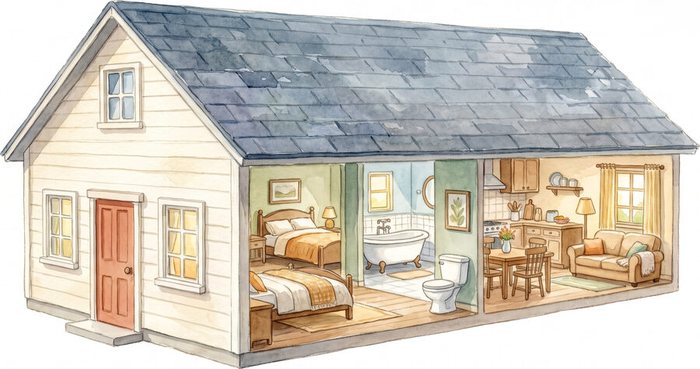
Watercolour cutaway of a house showing every room inside Thirty days

Print it. Use it at an actual open house.

If your child doesn't pick up a pencil, email us inside thirty days and we will refund you in full. Keep the files either way.